

Practical guide
What this guide solves
Plan passive-skill inheritance in Palworld 1.0: define a role, choose clean donors, consolidate traits and route them into your target Pal.
Use the matching Palpedia tool while you read.
Plan a breeding pathPassives
Define one job before choosing passives
Start with the final role: base worker, combat attacker, tank, mount or support. A passive that is excellent for work speed does nothing for a combat build, and a damage passive can occupy a slot that a base specialist needs for productivity or sustain.
Write the intended role next to the target species before breeding. This one decision prevents most wasted hatch cycles.
Passives
Use the cleanest donors you have
A donor is valuable because of the traits it carries, not because it is rare. Prefer parents whose useful passives match the final role and whose unwanted passives are limited. A crowded parent pool creates more combinations to sort through.
Keep separate donor lines for base work, combat and movement. That makes later projects faster because you can reuse a clean line instead of rebuilding it from random captures.
Passives
Consolidate before changing species
- Choose the final Pal and the passive set you want.
- Find two donors that collectively cover those traits.
- Breed the donors until the useful passives are concentrated into a manageable parent pair.
- Use Pal Finder or Breeding Path to move that pair toward the target species.
- Keep intermediate offspring that preserve the clean trait set, even if their species is not the final goal.
- Evaluate mutations and other random improvements only after the core inheritance line works.
Passives
Separate deterministic planning from chance
Palpedia can calculate species outcomes and multi-generation routes from versioned data. Passive inheritance, gender, IVs and mutation outcomes still contain randomness, so no route should be described as guaranteed.
Plan the deterministic part first: valid parents, valid child and a recoverable chain. Then decide how many hatch cycles the random optimization is worth.
Verification
Sources and review notes
Sources stay visible so this answer can be checked after patches. Palpedia distinguishes installed game data from third-party field reporting.
Keep learning
Related Palworld guides

Palworld 1.0 new Pals location atlas
A version-pinned field atlas for the full current 1.0 roster: Palpagos, the World Tree, encounter levels, night spawns and permanent Pal profiles.
Read guide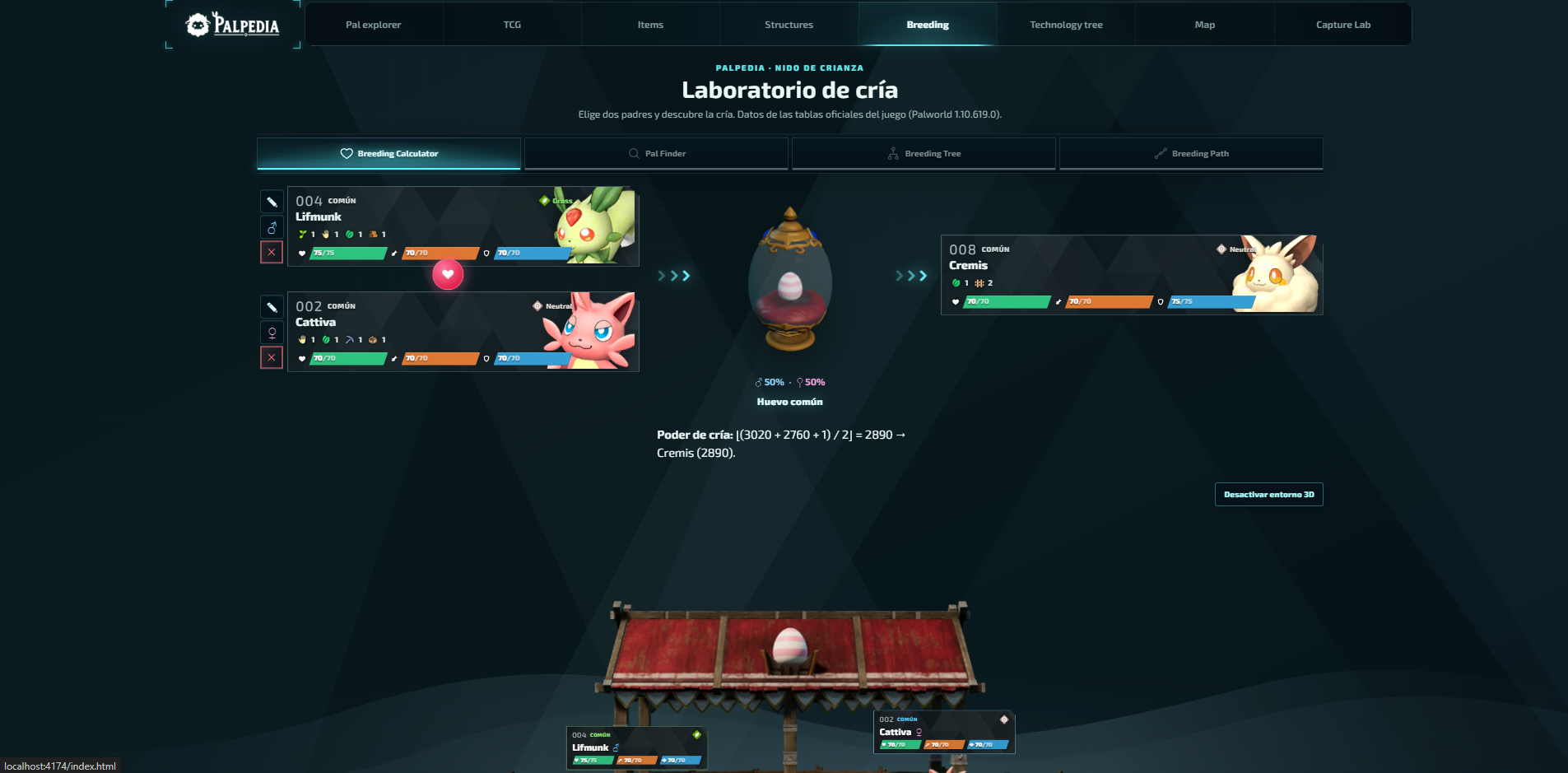
Palworld breeding calculator guide: parents, paths and trees
Choose the right calculator mode, find every parent pair for a target Pal and turn a long breeding chain into a plan you can actually follow.
Read guide
Best base Pals by work suitability in Palworld 1.0
A data-first shortlist for every base job, ranked by the unmodified work-suitability levels in Palpedia's current 299-Pal catalog.
Read guide